Senator Fahy, AM Steck Introduce Legislation to Protect Schenectady's Municipal Finances and Improve Local Court Facility Planning
January 23, 2026
Legislation addresses ongoing dispute between OCA and City of Schenectady over municipal court facilities
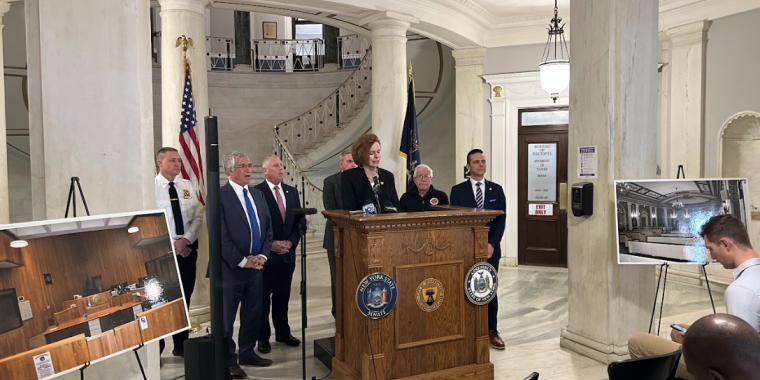
SCHENETADY, N.Y. – Today, State Senator Patricia Fahy (D–Albany), Assemblymember Phil Steck (D—Colonie), and Schenectady Mayor Gary McCarthy were joined by Assemblymember Angelo Santabarbara (D—Rotterdam), Assemblymember John T. McDonald, III (D—Cohoes), and Schenectady County Legislature Chair Gary Hughes to announce the introduction of new legislation (S.9022 Fahy/A.XXXX Steck) aimed at reforming the way New York State enforces court facility standards. This legislation eliminates the counterproductive ability of the Office of Court Administration (OCA) to withhold funds from municipalities it deems noncompliant.
“Cities and towns across our state do not and should not have to choose between providing basic municipal services and meeting unrealistic facility specifications that threaten their financial stability and exacerbates the precarious fiscal situation of many New York State municipalities,” said bill sponsor Senator Patricia Fahy (D—Albany). “Unfortunately, withholding state aid has been used as a blunt instrument to compel compliance with court facility mandates, with little consideration for local municipality needs, planning, or budgets. This legislation ends that practice and creates a fair, transparent process that respects local voices and two-way negotiations while ensuring we uphold our constitutional obligation to maintain safe, accessible court facilities.”
This legislation would eliminate the withholding, reduction, or seizure of state aid as the primary enforcement mechanism for court facility compliance, replacing it with reasonable administrative steps. It also establishes an independent Court Facilities Review Panel to review proposed facility plans for scope, feasibility, and proportionality, giving communities an opportunity to be heard. Finally, it creates a formal appeal process that pauses enforcement actions while disputes are resolved.
As reported in recent weeks, in the City of Schenectady, where the City is engaged in a protracted dispute with the Office of Court Administration (OCA) over inadequate municipal court spaces, the withholding of more than $10 million in critical state aid has jeopardized the city’s ability to meet payroll and maintain essential services, pushing Schenectady taxpayers into a precarious financial position.
Schenectady Mayor Gary McCarthy has sounded the alarm that current practices, where compliance can hinge on facility mandates, could have far-reaching consequences for basic municipal operations. This bill ensures that in the future, upstate and Capital Region communities like Schenectady, Albany, Buffalo, and Lackawanna will be supported by state policy and agency direction, rather than having their fiscal health undermined.
“Withholding state aid to force compliance with court facility mandates is an extreme and counterproductive approach that puts municipalities in an impossible position,” said bill sponsor Assemblymember Phil Steck. “Local governments should not be pushed to the brink of fiscal crisis or forced to choose between meeting payroll, delivering essential services, and complying with costly and often impractical facility demands. This legislation restores balance and common sense by ensuring disputes are resolved through a fair, transparent process that respects local planning realities while still upholding our responsibility to maintain safe and accessible courts.”
“Holding a city’s state aid hostage over a facilities dispute is reckless and wrong,” said Assemblyman Angelo Santabarbara. “Schenectady taxpayers are being punished for a problem they didn’t create, and essential services are being put at risk because a state agency is using financial coercion instead of common sense. It’s shameful that it’s going to take state legislation just to restore balance and basic fairness because this agency has refused to exercise restraint or common sense on its own. No community should ever be forced to choose between keeping the lights on and complying with unreasonable, one-size-fits-all mandates.”
"Times and needs have changed since the Unified Court System was established, and while we all agree our courts must be safe, modern, and efficient, those responsibilities should not be placed on the backs of local taxpayers, especially in cities already facing significant financial strain,” said Assemblymember John T. McDonald III, RPh. “I support Senator Fahy and Assemblymember Steck’s efforts to modernize outdated statutes that bind local governments. This legislation creates a more reasonable approach and ensures communities have a seat at the table. I look forward to working with my colleagues and the Office of Court Administration to reach a fair and sustainable solution.”
“The Office of Court Administration is an important branch of our government that plays a vital role in keeping our courts operating effectively. As a former public defender, I understand deeply the importance of ensuring our courts run smoothly for everyone involved in the justice system,” said Assemblymember Gabriella A. Romero (D, WFP–Albany, Guilderland, New Scotland). “However, court facility regulations have gone too long without being updated. This legislation simply modernizes those rules and brings them in line with today’s fiscal realities, so that municipalities are not forced to shoulder the costs of courthouse mandates without support. Fairness and transparency are critically important in the regulation of our court system - this bill helps to ensure both.”
“I’m grateful to Senator Fahy, Assemblymember Steck, and the entire coalition of legislators who are standing up for communities like Schenectady,” said Schenectady Mayor Gary McCarthy. “This bill brings long-overdue fairness, transparency, and oversight to a process that has allowed the Office of Court Administration to seek to impose expensive mandated court plans on small cities such as Schenectady. This legislation will level the playing field and bring fiscal reality to the municipal court planning process.”
“We’re grateful to our state legislative team—Senator Fahy, Assemblymember Steck, and Assemblymember Santabarbara—for sponsoring legislation that would allow the City of Schenectady to continue receiving critical funding for its courts, preventing those costs from being shifted to local taxpayers,” said Schenectady County Legislature Chair Gary Hughes. “As we prepare for the relocation of County offices to One Broadway Center, we’re working with the City to explore whether 620 State Street could play a role in the solution. Working together works.”
"Without this legislation, cities like Buffalo and Lackawanna could be put in a position where they have to choose between funding essential services and meeting court facility mandates,” said Senator April Baskin. I do not want to see cities in my district have critical funding withheld. This legislation creates a fair, transparent process that preserves local fiscal stability while ensuring safe, accessible, and functional courts. I’m proud to partner with Senator Fahy to sponsor this bill and give our municipalities a meaningful voice in these decisions.”
“Protecting state aid for our municipality is critical in the City of Albany,” said Albany Mayor Dr. Dorcey Applyrs. “We are already stretched thin enough, and utilizing the reduction of funding as an enforcement tool is counterintuitive towards the ultimate goal of court facility compliance, not to mention a potentially dangerous situation for municipalities. Maintaining essential City services for residents should always be the priority. I applaud Senator Fahy and Assemblymember Steck’s efforts to get this bill introduced.”
"Although Schenectady and other cities across New York are facing significant fiscal challenges, they do their best to comply with state mandates while relying on stable, predictable state aid to deliver services and plan responsibly,” said NYCOM Executive Director, Barbara Van Epps. “Consequently, the withholding of state aid, under any circumstances, puts the state-local partnership and municipal solvency at risk and therefore should never be an option. In addition to prohibiting the withholding of such aid, this legislation would allow municipalities to challenge a proposed court facilities plan, ensuring it is reviewed for reasonableness and necessity in light of a municipality’s fiscal and operational limitations. This approach would not only protect our communities from overreach by the State, but it would also reinforce the principle that the State and its local governments must be partners, not adversaries, when dealing with court facilities or any other shared responsibilities."
###
related legislation
Newsroom
Go to Newsroom