Harckham Supports Affordable Utility Costs with a Dozen Bills to Expand Solar Energy in NY
February 16, 2026
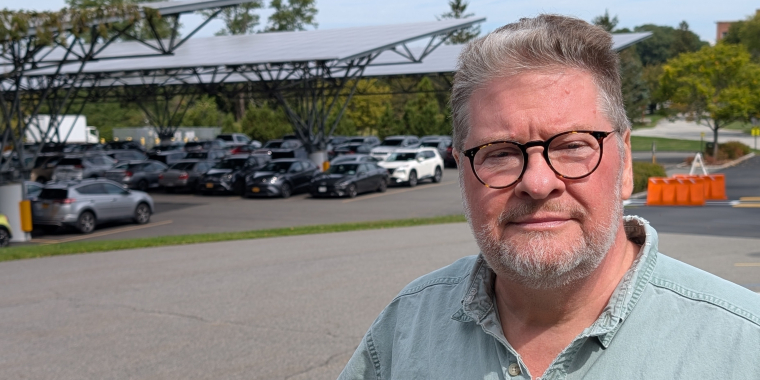
State Sen. Pete Harckham in front of the solar panel arrays at Maryknoll in Ossining
Legislation includes the Accelerate Solar for Affordable Power Act (ASAP) and expansion of residential solar power tax credits
Albany, NY – New York State Senator Pete Harckham has introduced a dozen bills so far in 2026 to increase solar energy production statewide to fight rising utility costs and support affordability measures, including the Accelerate Solar for Affordable Power Act (ASAP) and legislation to expand residential solar power tax credits.
“Solar energy is one of the most affordable energy sources available,” said Harckham. “By, streamlining the permitting and interconnection process, and strengthening programs that support solar installations, we can reduce project costs and delivers real savings to families, businesses, schools, and municipalities. That means more predictable energy bills and less exposure to volatile fossil fuel prices.”
Chief among Harckham’s dozen solar bills, the Accelerate Solar for Affordable Power (ASAP) Act (S.6570) would raise New York’s distributed solar target from 10 gigawatts (GW) to 20 GW by 2035 and implement common-sense reforms to lower costs and streamline deployment. It also advances critical interconnection reforms that will reduce costs, shorten project timelines, and allow for proactive grid investments to accommodate more solar capacity efficiently.
The ASAP Act also supports clean energy job growth and helps lower electricity costs for consumers by reducing reliance on fossil fuels. A new report from Synapse Energy Economics found that meeting New York’s energy storage goal and achieving the expanded solar goals outlined in the ASAP Act will lower electricity bills for New Yorkers by $1 billion per year, delivering savings across the state and all year-round.
Additionally, by directing the New York State Energy Research and Development Authority (NYSERDA), the Public Service Commission (PSC) and the Department of Public Service to continue the NY-Sun program, the ASAP Act will provide provides long-term market certainty, attract private investment and ensures that at least 35% of program benefits reach disadvantaged communities, further advancing equity and economic growth.
“This legislation is about more than just hitting a number,” said Harckham. “It’s about making sure our energy policies reflect the economic realities of everyday New Yorkers. It’s about helping renters, small businesses, houses of worship, and co-ops keep the lights on and bills low. And, yes, it’s about making sure New York’s 15,000-strong solar workforce continues to grow.”
Investments in solar energy will benefit the local, “main street” economy, added Harckham, creating good jobs for electricians, construction workers, engineers, and directly supporting small businesses in every region of the state.
A common-sense way for homeowners and others to save money is through a bill (S.2626) that increases residential solar tax credits (up to $10,000) for new solar energy installations, which will make renewable energy more affordable and accelerate its expansion through New York. Also beneficial is Harckham’s bill (S.5781A) to mandate use of the popular SolarAPP+ program to enable quicker permitting for residential solar applications.
This week, one of Harckham’s solar energy bills (S.270), which will streamline the parkland alienation process for solar installations over parking lots in public parks, was passed with overwhelming bipartisan support in the State Senate. Other solar-focused bills that Harkham sponsored will remove unnecessary barriers and make it easier to build solar where it makes the most sense: rooftops, parking lots, schools, college campuses, farms, and existing infrastructure.
Along with S.270 Harckham’s full list of solar bills include:
- S.1986: Extends energy performance contract limits for school districts to 25 years to increase the number of viable solar projects.
- S.2626: Increases the maximum for the residential solar tax credit to $10,000 and makes it refundable starting in 2025.
- S.4126: Extends the period municipalities can bond for solar projects from 5 to 25 years to improve financing options.
- S.4571A: Tasks NYSERDA with creating a floating solar program providing grants, technical support, and monitoring.
- S.5628: Creates a tax credit for "agrivoltaics," allowing farmers to combine solar and agricultural while preserving their agricultural tax assessment.
- S.5781A: Requires an automated online platform to simplify permitting for home solar and battery systems, allowing for faster local approvals and streamlined installations.
- S.6570: The ASAP Act; increases state solar goal to 20GW by 2035 and mandates grid interconnection reforms to help clear the backlog of systems awaiting approval to connect.
- S.6882: Authorizes carport solar under 5MW, with appropriate agricultural impact mitigation, as-of-right in any non-residential zoning district.
- S.8694: Requires the MTA to identify suitable parking lots and install solar canopies on 75% of that space by 2040.
- S.8696: Requires SUNY institutions to survey parking facilities and utilize 75% of suitable space for solar canopies by 2040.
One of Harckham’s solar bills, S.8012, which creates a consistent property tax assessment method for solar and wind systems, giving developers and local governments regulatory clarity, was signed into law by Governor Hochul in December 2025.
Half of all new electricity generation is from solar power according to the US Energy Information Agency, with Texas–the home of America’s fossil fuel industry–leading the way. Scaling up solar energy is not just about cleaner air and a healthier environment. It is a question of economics, jobs and affordability. By reducing our dependence on fossil fuels, whose price can spike abruptly because of weather or other supply disruptions, solar power can create financial stability for households. Moreover, solar is a scalable resource that can be quickly deployed to meet rising demand for electricity from consumers and businesses at a time when, according to industry sources, the lead time for new gas plants has exploded to 5-7 years.
In a recent op-ed, Harckham noted that in December 2025 more than 1.3 million utility customers in New York were more than two months behind on electric and gas bills to the tune of $1.8 billion. This explains why households and municipalities searching for a less expensive and more reliable form of energy are turning to a clean, renewable energy source: solar.
After all, renewables are the cheapest new power source around the world. A kilowatt-hour of solar is cheaper than a kilowatt-hour of electricity derived from natural gas, oil or nuclear power.
Not only can installing solar deliver $1,500+ in annual electric bill savings for a typical household, rooftop and community solar projects paired with energy storage will lower prices for everyone by increasing New York’s energy supply to meet rising demand.
“It's simple: adopting more renewable energy, like solar, will result in lower utility costs for millions of New Yorkers,” said Harckham. “I will continue to sponsor legislation to support our ratepayers, municipalities and business owners.”
Noah Ginsburg, Executive Director, New York Solar Energy Industries Association, said, “As New York's leaders seek to tame rising energy costs, solar and energy storage are their most powerful tools. Senator Harckham’s ASAP Act will unlock one billion dollars of annual savings for all New Yorkers by expanding rooftop and community solar deployment in every corner of the State.”
Stephan Edel, Executive Director of NY Renews, said, “Solar is the least expensive electricity source on earth, and New York’s most successful clean energy sector. Building out solar energy systems on rooftops and in communities is a powerful way to expand affordable energy access to low-income and disadvantaged neighborhoods, create good-paying jobs, and accelerate our state’s transition to clean, abundant, and low-cost energy. The ASAP Act will help us get there as soon as possible.”
Marguerite Wells, Executive Director of the Alliance for Clean Energy, said, “Rapidly deploying additional solar energy is the win-win-win New York needs. It addresses our affordability crisis, it helps in the fight against climate change, and it helps our struggling upstate towns with much-needed new tax revenue. We applaud Sen. Harckham for recognizing this fact and moving towards removing the red tape that keeps New York from fully embracing this technology.”
related legislation
Newsroom
Go to Newsroom
Harckham Hosts Senior Resource Fair in Yorktown Heights
September 22, 2026

Support Connection Receives $50K Investment Thanks to Harckham Grant
September 17, 2026