Senator Addabbo Hosts Problem Gambling Awareness Month Event for Students at John Adams High School
March 9, 2026
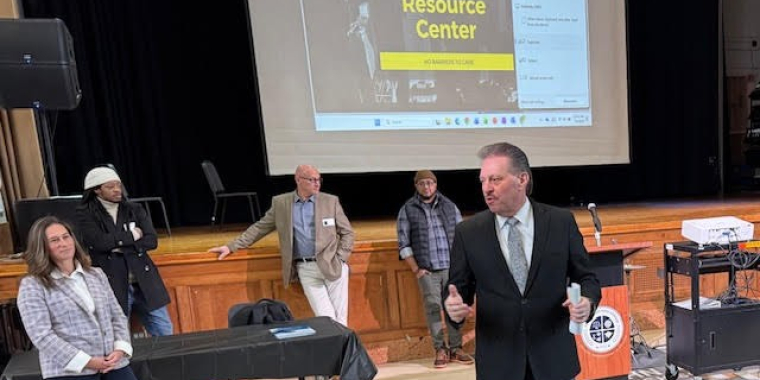
Senator Addabbo speaks with students at John Adams High School about problem gambling.
In recognition of March as Problem Gambling Awareness Month, Senator Joseph P. Addabbo, Jr., the Chairman of the Senate Committee on Gaming, Racing and Wagering, partnered with the New York Council on Problem Gambling (NYCPG) to host two educational sessions on March 6, 2026, at John Adams High School for its students only, regarding the dangers of gambling addiction.
“Teaching kids about the risks of gambling addiction is more than a responsibility —it helps their future,” Addabbo said. “If we raise awareness and understanding, we help them make smart choices and protect themselves from addiction that can ruin their dreams.”
The representatives presented important information and shared real-life experiences with 100 students. Robin Singh, the Team Leader of the Queens Problem Gambling Resource Center of NYCPG gave an overview of gambling addiction, such as warning signs and resources to get help. He was joined by Michelle Hadden, the Executive Director of NYCPG and Kristin Sweeter, its Assistant Executive Director.
Treyvon Paul and Scott Meyer, both NYCPG Certified Peer Recovery Advocates, shared their personal stories as recovering gambling addicts.
Singh started by explaining what gambling is: risking something important on a game of chance to win a prize. He noted that problem gambling harms daily life, through lying or stealing to pay debts or using money meant for rent or bills.
“The sign that we see very often in our job is chasing losses,” Singh said. “Chasing losses means putting more money back in to get the money back that you lost. It’s like trying to dig yourself out of a hole with a shovel. If you’re in a hole and you have a shovel, can you dig your way up? Where are you going? Down. More often than not, people who try to get back their losses end up losing again and then they have twice as much loss. It’s compounded loss. For a lot of people, that is how the cycle of problem gambling begins.”
Singh also explained the “spectrum of gambling,” which goes from no gambling to casual social gambling, then to problem gambling, and finally to gambling disorder. The line between social gambling and problem gambling can blur in things like why someone gambles, what they expect to get, how they spend time and money, how they react to losses, and how much they tell others.
Treyvon Paul spoke about how his desire to become a professional video game player and his talent that put him in the top 1,000 players in North America back when he was in his twenties triggered a pattern of behavior that led to problem gambling. He developed signs that included lying, feeling exhausted, missing work, and chasing losses.
“At first I kept winning and that was the worst possible thing that could have happened, and then when I didn’t win, I thought it was a mistake, like there was some glitch in the system,” Paul said. “I thought I was one bet away from getting everything back.”
He also said that by age 23 or 24 he was tens of thousands of dollars in debt and had to lie to find ways to keep funding his habit. “I had to lie to myself in order to lie to them,” he said. “I was the give-me-money guy.”
Scott Meyer also spoke about his battle with addiction, something that affected his job as an accountant, his family life with his wife and five children, by causing him to drown in massive debt, landing him in prison for four years and spurring four suicide attempts.
“It doesn’t matter if you are tall, short, black, white, Asian, Jewish, Catholic, Muslim, the gambling addiction doesn’t give a damn,” Meyer said. “It doesn’t care how much money you have, how old you are, or where you live, because it’s right in the palm of your hands, it’s right around the corner. Gambling addiction will come get you and take you to the bowels of hell.”
“It will torture you, in silence, in shame, in fear, because who are we going to tell that we are making an ethical choice to gamble,” he added.
But Meyer did get help and now he says his life is great and he is enjoying family life and time with his three grandchildren while helping others as a peer advocate with NYCPG.
Senator Addabbo would like to thank the NYCPG and John Adams High School for coming together for the benefit of educating youth about the dangers of gambling addiction.
For more information and to get help, call the NYS OASAS HOPEline anytime at 1-877-846-7369.
Newsroom
Go to Newsroom